Emblem Replaced 10 APIs with Definitive Flash, Freeing Resources for Its Next-Gen AI Terminal
Jun 2026 · 8 min read · Definitive Team
“We decided to move to Definitive Flash for our conditional engine in order to improve our efficiency and reliability on the offering. After building and operating our own conditional engine that was custom built over the past year, we’ve decided to allow a more experienced team to handle execution and infrastructure so that we can focus on the application layer of our products.”
— Jake Gallen, CEO at EmblemAI
Highlights
- EmblemAI, a natural language AI terminal for builders and traders, is moving its advanced order execution onto Definitive’s Flash API across the EVM and Solana chains it supports.
- One year of in-house work, replaced by one integration. EmblemAI built and ran its own cross-chain conditional engine for over a year. Flash takes over execution so the team stops maintaining it.
- Ten APIs, consolidated into one. Flash lets EmblemAI sunset the routing, RPC, and market-data services its conditional engine was stitched from, including 0x, Uniswap X, Alchemy, CoinMarketCap, Jupiter, and DEXScreener.
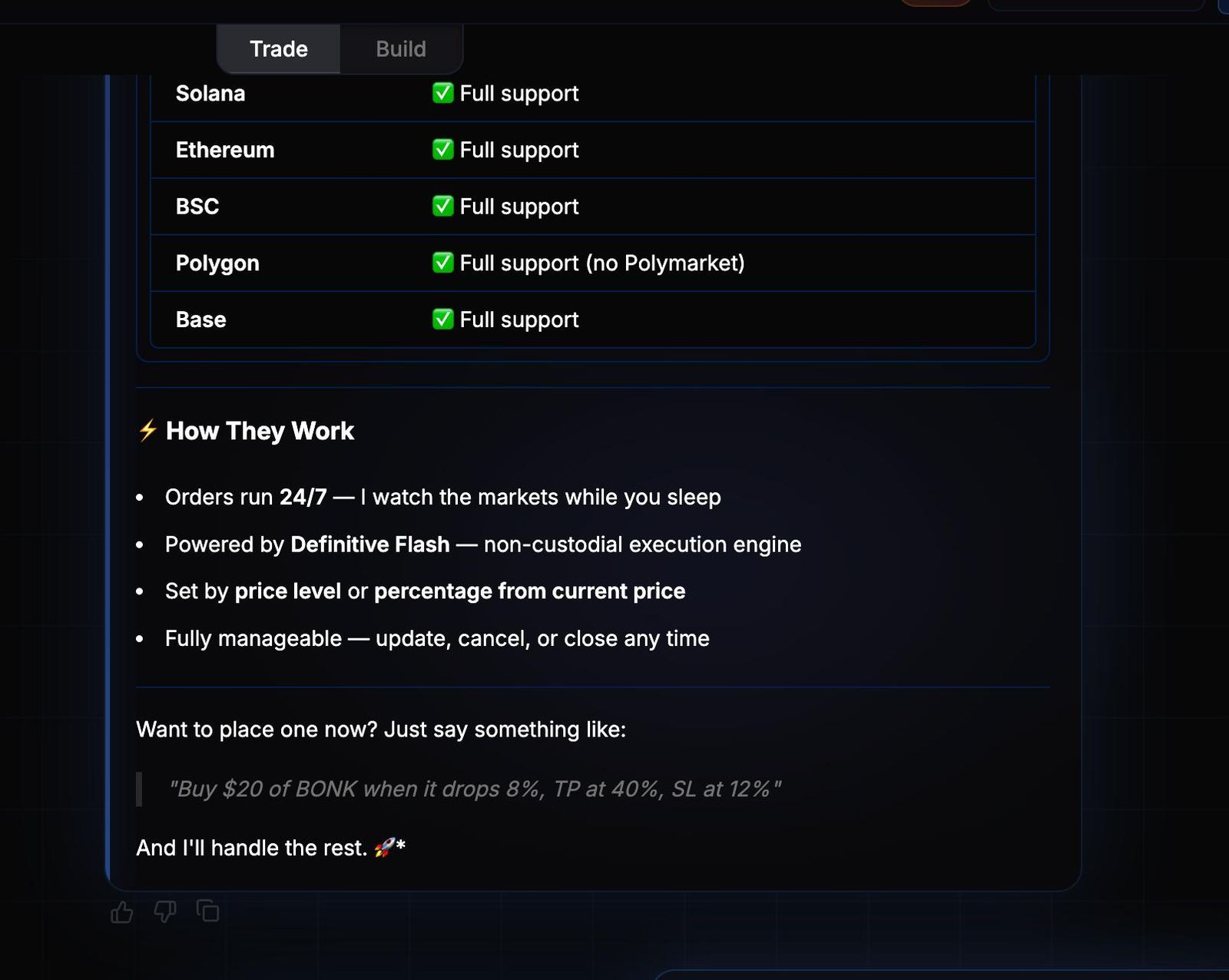
- The advanced order suite, exposed through natural language. Limit, DCA, Take Profit, Stop Loss, and Market orders, placed by typing intent into the terminal instead of clicking through an interface.
- Reliability where it was breaking. EmblemAI’s own engine broke consistently on Solana. Flash is built to land conditional orders across EVM and SVM through a single API.
- Engineering routed to the moat. With execution handled, EmblemAI’s team focuses on its vibe coding platform for crypto apps, where users build and trade onchain in the same flow.
What is EmblemAI?
Emblem is an AI terminal for builders, creators, and traders. Traders execute onchain transactions across seven plus blockchains by typing what they want in plain English. Builders use the same terminal to vibe code crypto applications: describe an app, and the terminal helps assemble it on top of EmblemAI’s onchain tooling.
The team is not new to cross-chain infrastructure. EmblemAI grew out of Emblem Vault, which has been shipping cross-chain technology since 2016, and in April 2026 consolidated its products and communities under a single identity. Today the terminal exposes a deep library of onchain tools across chains including Solana, Ethereum, Base, BNB, Polygon, Hedera, and Bitcoin, with support for AI agent protocols so both people and agents can drive it.
The product’s bet is that the interface to crypto becomes language. The hard part is what sits underneath that language. A terminal can parse “set a limit order to sell when ETH hits my target” in a second. Making that order actually fill, on the right chain, at the right price, weeks later, is the part that takes a trading desk to build.
The challenge: keep an in-house conditional engine alive, or focus on the product moat
EmblemAI did the hard thing first. The team built its own cross-chain trading engine spanning SVM and EVM chains, and started building its conditional order engine about a year ago. It has maintained both ever since.
Running that infrastructure turned into a constant tax. The cross-chain engine was difficult to manage, and on Solana in particular it tended to break consistently. Every conditional order type carries its own failure modes: price monitoring that has to stay live for days, execution that has to fire at the right moment, retries when a chain congests, and chain-specific quirks that differ between EVM and Solana. None of it is a one-time build. It is a standing on-call burden.
That engine was also a web of outside dependencies. Keeping it running meant maintaining 10+ third-party APIs and services at once: routing and liquidity from 0x, Uniswap, and others; Alchemy for RPC access; and a patchwork of pricing and token-data feeds including CoinMarketCap, Jupiter, Dexscreener, and Solana Tracker. Each one is its own integration to watch, its own way to break, and its own bill.
For a team whose actual product is a natural language terminal and a vibe coding platform, every hour spent keeping the conditional engine running was an hour not spent on the layer that differentiates them. The build-versus-maintain math stopped favoring in-house. As the team put it, after a year of operating a custom engine and dealing with the inconsistencies, the better move was to partner on this tooling: improve efficiency, and cut the resources required to offer the service.
What EmblemAI needed was a conditional execution layer that already worked across EVM and Solana, that someone else was responsible for keeping reliable.
The solution: Definitive’s Flash API as EmblemAI’s execution rail
Definitive is the onchain trading platform built for pro traders and institutions, by a team with roots at Tagomi and Coinbase Prime. The same execution engine that professional desks and DeFi funds use on Definitive’s terminal is exposed through Flash API, and that engine is what now sits under EmblemAI’s advanced orders.
Conditional orders that someone else keeps reliable
This is the part EmblemAI was carrying itself. Flash ships Limit, Stop Loss, Take Profit, and TWAP as standard order types, plus DCA and a Quick Trade mode for high-volatility tokens. Each is one parameter change on a single endpoint. Flash’s execution engine continuously evaluates market pricing and fires the order when conditions are met, across EVM chains and Solana through the same integration. The breakage EmblemAI saw on its own Solana execution becomes Definitive’s responsibility to manage, not EmblemAI’s.
Advanced orders driven by natural language
In EmblemAI’s terminal, a user does not fill out an order ticket. They state intent, and the AI agent places a limit order, a TWAP, a take profit, or any supported advanced order across the chains Definitive covers. Flash’s API surface is a clean fit for that: it is stateless and REST-based, returns clean JSON, and is designed to be consumed by both engineering teams and LLMs. The terminal translates language into a Flash quote and order call, and Flash lands the trade.
Managed execution from intent to settlement
Advanced orders are not just endpoints. Behind each one, Flash handles gas estimation, nonce management, MEV protection, slippage bounds, transaction simulation, retry logic, and route selection across 900+ unique liquidity sources and market makers. The user signs an intent. Flash gets it onchain. The whole class of execution problems that was breaking EmblemAI’s engine on Solana is the problem Flash exists to absorb. One integration also replaces the separate aggregators, RPC provider, and price feeds EmblemAI was wiring together by hand, since routing and the market data behind it now arrive in the same Flash response.
Non-custodial, including for conditional orders
EmblemAI’s terminal gives every user a wallet, so custody model matters. Flash is non-custodial even for orders that sit open for days: tokens stay in the user’s wallet until the moment a trade executes, with a one-time approval and a per-order signature that caps exactly what can be pulled. Open limit orders are held offchain rather than posted onchain, so they are not exposed to MEV bots before they fire. That fits a product where the wallet, and the user’s control of it, is the point.
Engineering velocity routed back to the product
Handing execution to Definitive frees EmblemAI’s team to build the layer that is actually theirs: a vibe coding platform for crypto applications that plugs into the same onchain execution agent, so users can build apps and land onchain trades in one flow. The conditional engine stops being a thing the team maintains and becomes a capability the team consumes.
10 APIs - Consolidated into One
Emblem’s move from internal build to Definitive Flash means:
- Orders that land. EmblemAI’s goal in moving to Flash is execution that works reliably across chains, including the Solana path that broke on its own engine.
- 10 APIs, consolidated into one. The custom conditional engine and the stack of third-party services behind it, from 0x and Alchemy to CoinMarketCap and DEXScreener, can be consolidated into just one - Definitive Flash API.
- Team focus shifts to the application layer. Engineering moves to the vibe coding platform and the AI agent that ties building and trading together.
Built to power what comes next
EmblemAI is converging two ideas that are usually separate: building crypto apps in natural language, and trading onchain in natural language. The vibe coding platform is where the team’s moat sits, with the onchain execution agent underneath it so a user can build an app and have it transact in the same session.
Replacing internal trade infrastructure with Definitive Flash API is what makes EmblemAI’s focus on product experience possible. Definitive’s mission is to bring professional-grade execution to DeFi, and Flash API is how that reaches beyond Definitive’s own terminal. Wallets, AI agents, fintechs, and consumer apps can plug into the same smart router, the same advanced order types, and the same multi-chain coverage that professional trading desks rely on, through one API.
EmblemAI is clear proof of the pattern: a team that built its own trading engine chose to replace it with Definitive Flash so it could focus on the app layer. EmblemAI doesn’t win by rebuilding every piece of trading infrastructure internally. It wins by making crypto easier to build with, easier to automate, and easier to use through natural language.
Learn more about EmblemAI: emblemvault.ai | X: @EmblemVault
Learn more about Definitive’s Flash API: flash.definitive.fi/docs | X: @definitivefi



©2025 All Rights Reserved