The $50M Swap Failure That Proves Execution Quality Matters in DeFi
Mar 2026 · 8 min read · Definitive Team

The $50M Swap Failure That Proves Execution Quality Matters in DeFi
A trader recently suffered a ~$50M loss executing a single large market swap through Aave’s front-end, which routed the order through CoW Swap. The trader sent $50M USDT and received just 324 AAVE worth $36K in return — a catastrophic outcome that exposed fundamental shortcomings in how most DeFi trading platforms handle institutional-scale orders. While the scale was extreme, incidents like this recur in DeFi every few months. This article examines what went wrong, where accountability lies, and how Definitive Prime is purpose-built to prevent exactly this kind of outcome.
Why execution quality matters in DeFi
A recent trade showed just how badly execution can break down in DeFi.
A trader used Aave’s swap interface to exchange roughly $50 million of USDT for AAVE. The order was routed to CoW Swap for execution. In the end, the trader received only about 324 AAVE, worth roughly $36,000 at the time.
This incident is an extreme example, but the broader issue is familiar: many DeFi trading interfaces are not built for institutional-size orders. They can surface a quote, process a swap — and still completely fail the trader’s intended outcome. In TradFi, recourse may be possible for “fat finger errors”. In DeFi, no such recourse is possible, and that merits guardrails in extreme cases.
What went wrong
This was not a smart contract hack, and the funds did not disappear. The trade executed as routed. The problem was the order was pushed through a path with nowhere near enough liquidity to support it. The result was catastrophic price impact, an outcome that should have been caught before the trade was ever executed.
As the swap moved through the market, the trader bought a small amount of AAVE near the market price. But as the order kept consuming liquidity, the effective price got worse and worse. By the end of the trade, the trader was paying massively inflated prices for the remaining AAVE.
That distinction matters. This was not a slippage issue. It was a price impact issue. In plain English: the market moved against the trade because the trade itself was too large for the available liquidity in the chosen trade route. And that outcome was knowable in advance.
Where the value went
The missing value did not vanish. It was redistributed:
- Block Builder: Titan Builder, a block builder, collected $33.1M to process the block.
- MEV Bots: Multiple MEV bots collected a total of $12.6M by executing sandwich attacks and arbitrage strategies.
- Liquidity Providers: $2.9M was collected by the liquidity providers that provided liquidity to the shallow SushiSwap pool used.
- Validator: The block validator collected $1.2M from the block builder.
- Protocols: Aave & CoW Swap collected $619K in protocol fees from the swap.
In other words, the system worked for everyone involved except the trader.
Why Aave and CoW Swap’s system designs were responsible
This outcome was not the result of one trader making a bad decision. It was the product of multiple system design choices across Aave’s swap interface and CoW Swap’s execution logic.
- Aave did not appear to run a competitive best-execution check before routing the trade to CoW Swap. The order appears to have moved to CoW Swap’s solver network without a real comparison of whether deeper liquidity or a safer execution venue existed elsewhere.
- CoW Swap’s quote logic appears to have used far too weak a standard. CoW Swap’s system appears to accept any route that is merely executable and returns a non-zero amount of output. For a $50 million order, that is not a real safety check. “Executable” only means the trade can be completed mechanically. “Non-zero” only means the trader gets something back. Neither says anything about whether the route is economically rational.
- That quote logic allowed a route that was clearly catastrophic. In this case, the order found a path that could technically be completed, but only by destroying nearly the entire value of the trade. The system treated that as valid when it should have rejected it outright.
- There was no real economic sanity check. By the time the order was ready to execute, the expected outcome was already wildly disconnected from market reality. A well-designed trading system should catch that immediately. It should recognize when the quoted result is far outside normal market conditions and block the trade rather than asking the user to approve the damage.
- Aave used a warning checkbox where a hard stop was needed. A checkbox may be acceptable for ordinary swaps with moderate risk. It is not an adequate control when the probable outcome is a 99%+ loss in value. At that point, the product should no longer treat the issue as trader preference. It should treat the trade as unsafe and refuse to process it.
Taken together, these were not edge-case misses. They are structural failures in how Aave and CoW Swap handle routing, validation, and user protection. The systems were designed to let the trade proceed as long as it was technically possible, and not to stop it when it was economically irrational.
How Definitive is different
Definitive offers two products, Definitive Turbo and Definitive Prime. Both products are built around one principle: execution quality for the trader comes first.
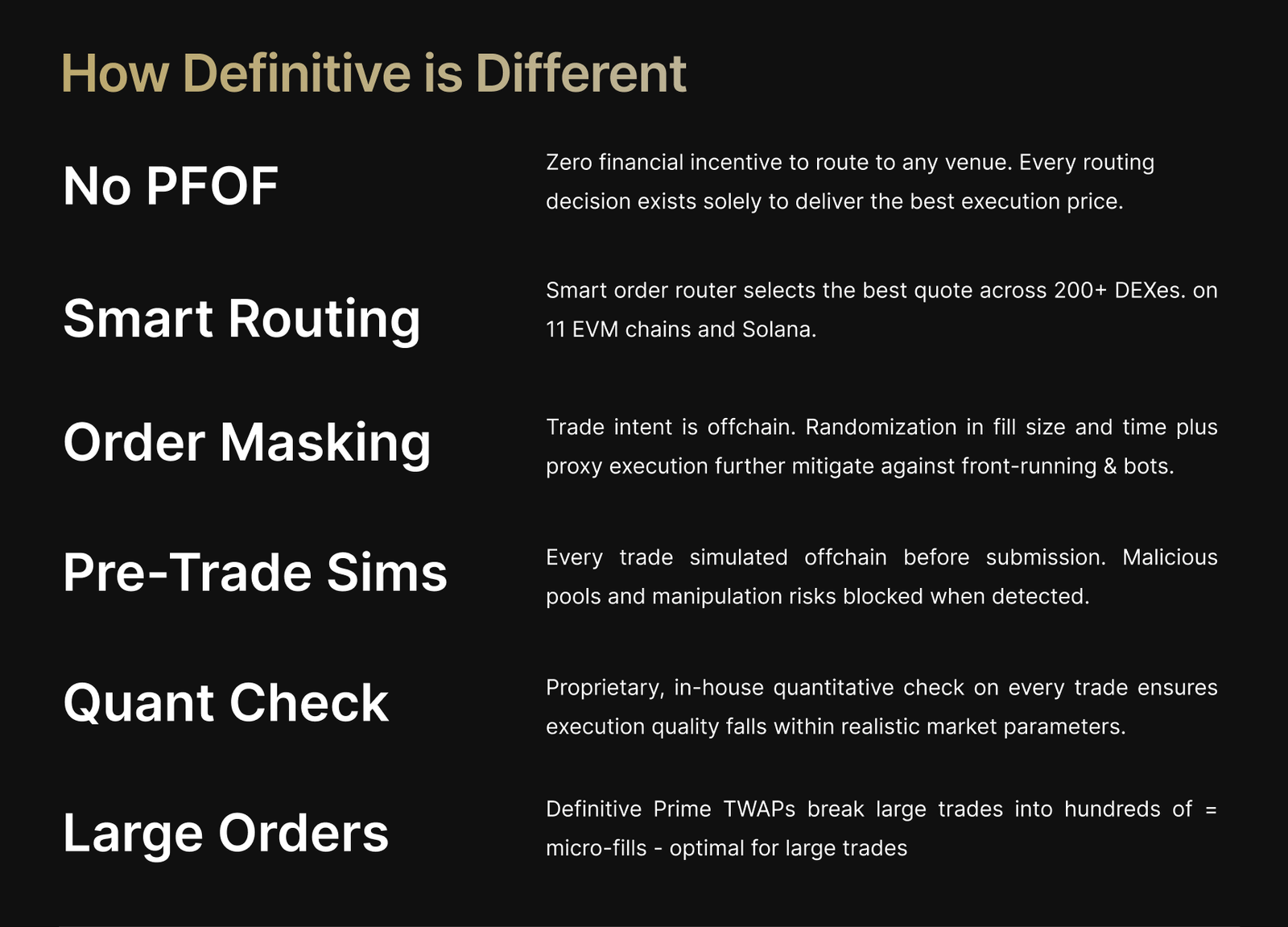
- Broader liquidity access. Definitive sources liquidity across 200+ DEXes and 15+ offchain market makers. That gives traders access to a much wider pool of execution options instead of relying on a single default choice.
- No payment for order flow. Definitive has no business incentive to steer trades toward a preferred venue, liquidity source, or counterparty. Routing decisions are made to get the best result for the trader.
- Trade intent is kept offchain to protect privacy. Unlike other swap platforms, traders’ intents are not broadcast on public mempools. Instead, they are held offchain, and only submitted at the time of execution to mitigate against front-running and malicious MEV bots.
- Pre-trade simulation before anything goes onchain. Every order is checked before submission to catch abnormal execution, bad routes, unsafe venues, or other signs that the expected outcome does not make sense. This matters in thin, fragmented, and fast-moving DeFi markets.
- A proprietary quantitative safety layer on every trade. Definitive applies an in-house quant check to determine whether an expected trade outcome is realistic. The technology is proprietary, but the goal is simple: identify abnormal conditions and stop the trade before capital is exposed.
- Guardrails kick in when conditions fall outside normal parameters. Definitive does not rely on a generic warning for trades that are clearly unsafe. When the expected outcome is unrealistic, the system is designed to intervene before execution.
Definitive Prime TWAPs: Optimal for large orders
For institutional-size trades, the right answer is often not a single swap at all. Definitive Prime was purpose-built for large trades in DeFi without sacrificing execution quality.
Definitive Prime TWAPs are designed for exactly the use case the trader attempted to execute on Aave and CoW Swap. Instead of forcing a large order into the market all at once, Prime’s TWAP breaks it into hundreds of smaller trade segments and executes them over time (from 10 minutes, and up to 30 days). That reduces market impact, improves average execution price, and makes the order less visible to predatory participants.
Each segment can be priced against the best liquidity available at that moment across Definitive’s full network of aggregated liquidity sources. Execution timing and sizing are randomized to help reduce “signaling risk” and makes the order harder for MEV bots to detect and exploit. Every trade segment is randomly assigned to a Definitive proxy address for execution to protect the trader’s privacy and intent. TWAPs can be used over periods as short as 10 minutes, or as long as 30 days to achieve best execution onchain for large trades.
For institutional and large traders, this is not a nice-to-have. It is a necessary tool to bring institutional-grade execution quality to DeFi.
The advancement of DeFi relies on tools like Definitive Prime
This incident highlights a broader truth about onchain trading: not all trading platforms are equal.
Many DeFi interfaces are designed to make swaps possible. Fewer are designed to deliver safe, high-quality outcomes for large trades. When routing logic is lacking, liquidity is not evaluated deeply enough, and pre-trade safeguards are weak, traders can pay an enormous price.
Definitive was built for a different standard.
No hardcoded venue preference. No payment for order flow. No dependence on third parties whose incentives are not aligned with the trader’s. Instead, Definitive combines broad liquidity access across 12 chains, institutional-grade smart order routing, pre-trade simulation, quantitative safety checks, and advanced execution tools like TWAPs to protect traders from end-to-end.
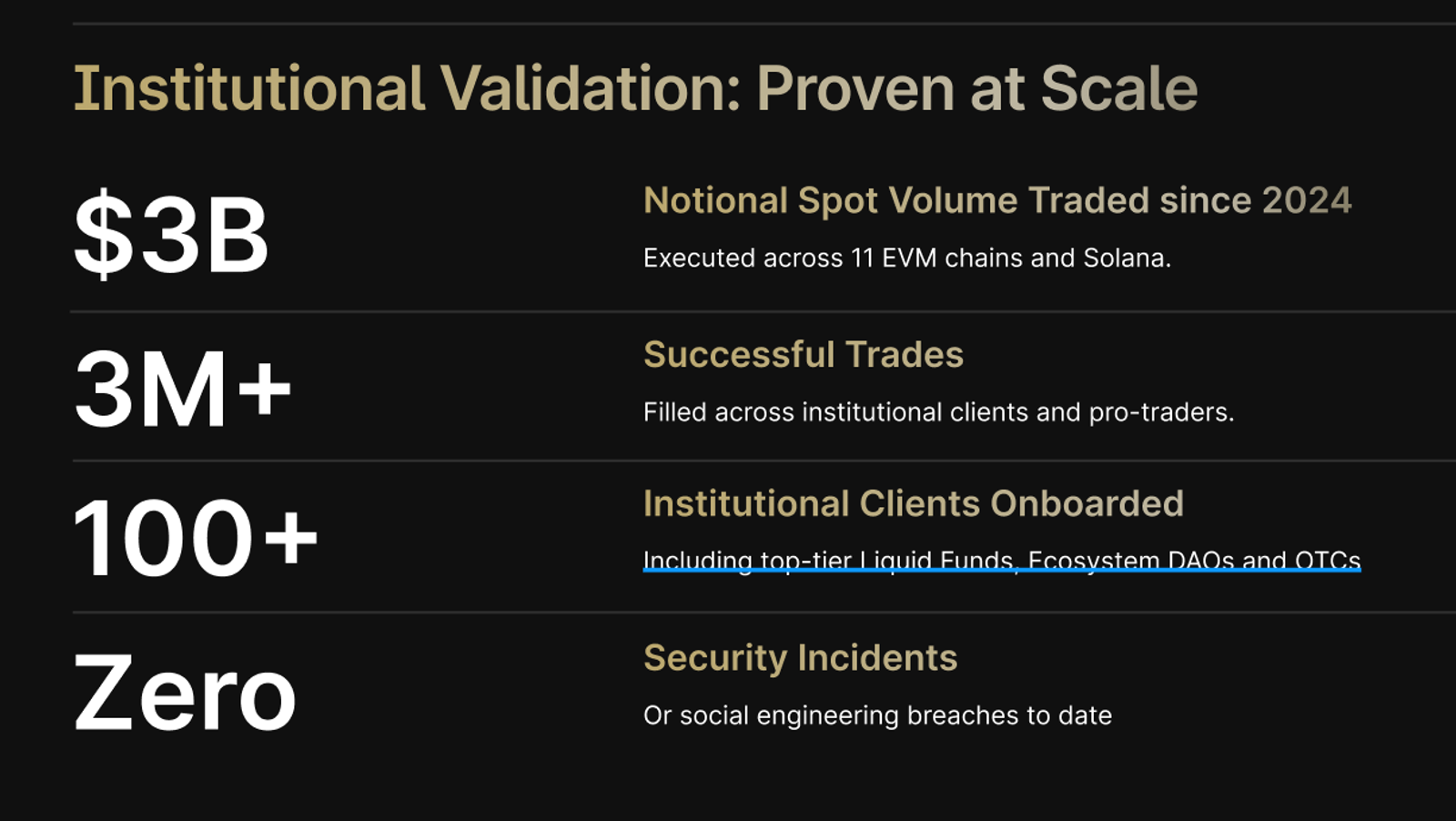
That is why leading hedge funds, liquid funds, and OTC desks already prefer Definitive for onchain trading. Because at Definitive, execution quality is not a detail. It is the product.
To learn more about Definitive, visit www.definitive.fi or contact us at [email protected]



©2025 All Rights Reserved